
NEWS
Restoring TB Services: State TB Programme Responds to GWIHR Community-Led Monitoring Findings


Restoring TB Services: State TB Programme Responds to GWIHR Community-Led Monitoring Findings
On September 7, 2026, the Greater Women Initiative for Health and Rights (GWIHR) State Advocacy Team led a strategic follow-up advocacy visit to the Abia State Tuberculosis and Leprosy Control Programme (STBLCP), calling for urgent action to address gaps in tuberculosis screening services identified through Community-Led Monitoring (CLM). The engagement, held at the State TB Programme office within the SACA Complex, Abia State Specialist Hospital, Amachara, Umuahia South LGA, brought together the GWIHR programme team, the Network of People Living with HIV/AIDS in Nigeria (NEPWHAN) Abia State Chapter, the State TB Network Coordinator, and a media representative from the Broadcasting Corporation of Abia (BCA).
Presenting findings generated through GWIHR’s CLM activities, the organisation’s Programme Officer, Mr. Vena Daniel, revealed that gaps in TB screening services had been identified at Okwulaga Primary Health Centre and Umuda Isingwu PHC. Despite serving as important points of care within their communities, clients requiring TB screening at the two facilities were being verbally referred elsewhere rather than screened directly at the facilities. GWIHR raised concerns that referrals without an effective mechanism for documentation and tracking could result in clients being lost along the referral pathway, contributing to delayed diagnosis, missed opportunities for early TB detection, and delays in treatment initiation.
Further investigation by the CLM team identified different factors affecting services at the two facilities. At Okwulaga PHC, a prolonged shortage of sputum cups required for TB sample collection had affected the facility’s ability to screen clients suspected of having TB. At Umuda Isingwu PHC, the challenge was linked to the absence of a trained Directly Observed Treatment (DOT) officer, leaving the facility without the required trained personnel to effectively provide TB screening and related services. GWIHR stressed that such gaps at the PHC level could create additional barriers for community members, who may have to travel longer distances, incur transportation costs, or fail to complete referrals to other facilities.
The advocacy team also raised concerns over a reported **₦5,000 charge associated with TB services at Healing Cross Hospital**. According to findings presented during the engagement, the hospital had previously informed the CLM team that it independently purchased TB screening materials from the open market because it was not receiving programme support for the service, with the associated cost consequently passed on to clients. GWIHR warned that such out-of-pocket expenditure could discourage people, particularly those with limited financial resources, from accessing timely TB screening and therefore called on the State TB Programme to investigate the situation and explore appropriate support for the facility.
The advocacy engagement also highlighted progress recorded through previous CLM follow-up. At Madonna Catholic Hospital, sputum cups had been restored following an earlier stock-out that affected TB screening. GWIHR commended the improvement as evidence of how continuous monitoring, advocacy, and stakeholder engagement can contribute to resolving identified service-delivery gaps.
Responding to the findings, the Abia State Tuberculosis and Leprosy Control Programme Manager, Dr. Afamefula, commended the GWIHR CLM team for bringing community and facility-level evidence directly to the State Programme. Addressing the situation at Okwulaga PHC and Umuda Isingwu PHC, he clarified that **both facilities are designated DOT sites and should therefore be providing TB services**, acknowledging that the reported absence of screening services required further investigation.
Dr. Afamefula explained that routine transfers of trained government healthcare workers could contribute to interruptions in TB services where trained personnel are moved without immediate replacement. In a key commitment arising from the advocacy, he pledged to engage the relevant **LGA TB focal person to establish why TB services were not being provided at Okwulaga PHC and Umuda Isingwu PHC and facilitate action towards restoring the services**. Where the interruption is linked to the transfer or absence of trained personnel, the State Programme would work towards identifying an appropriate replacement or alternative arrangement.
Addressing the commodity challenge, the Programme Manager disclosed that the State TB Programme currently had sufficient quantities of sputum cups to serve health facilities across Abia State for approximately one year. He therefore encouraged both public and private health facilities to formally request sputum cups from the State Programme whenever supplies are required rather than allowing screening services to be interrupted because of commodity shortages.
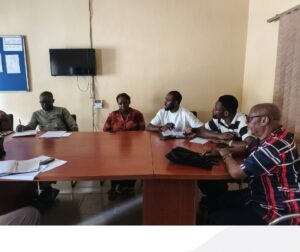
On the reported ₦5,000 charge at Healing Cross Hospital, Dr. Afamefula requested that GWIHR conduct further investigation to determine whether the amount represented a general hospital registration or card fee or was being charged specifically for TB screening. He clarified that while the State TB Programme might have limited authority over general administrative charges imposed by a private hospital, **the programme would intervene if GWIHR confirms that clients are being charged specifically for TB screening**. He further explained that facilities requiring sputum cups could formally request them from the State Programme instead of independently purchasing the commodities and transferring the cost to clients.
Beyond the immediate service-delivery concerns, Dr. Afamefula acknowledged the growing contribution of Community-Led Monitoring to the state’s TB response and assured the advocacy team that he would highlight the impact of CLM implementation in Abia State during relevant national and regional TB programme meetings. This would provide an opportunity for experiences and results generated through community monitoring in the state to be shared with TB programme stakeholders beyond Abia.
The advocacy engagement therefore secured a clear pathway towards investigating and restoring TB screening services at Okwulaga PHC and Umuda Isingwu PHC, while also establishing a follow-up process for the reported ₦5,000 charge at Healing Cross Hospital. GWIHR will follow up with the hospital to establish the exact nature of the charge and communicate its findings to the State TB Programme for appropriate action. The engagement further demonstrated how Community-Led Monitoring can connect evidence from communities and health facilities with decision-makers and support practical actions to improve the availability, accessibility, and affordability of TB services in Abia State.